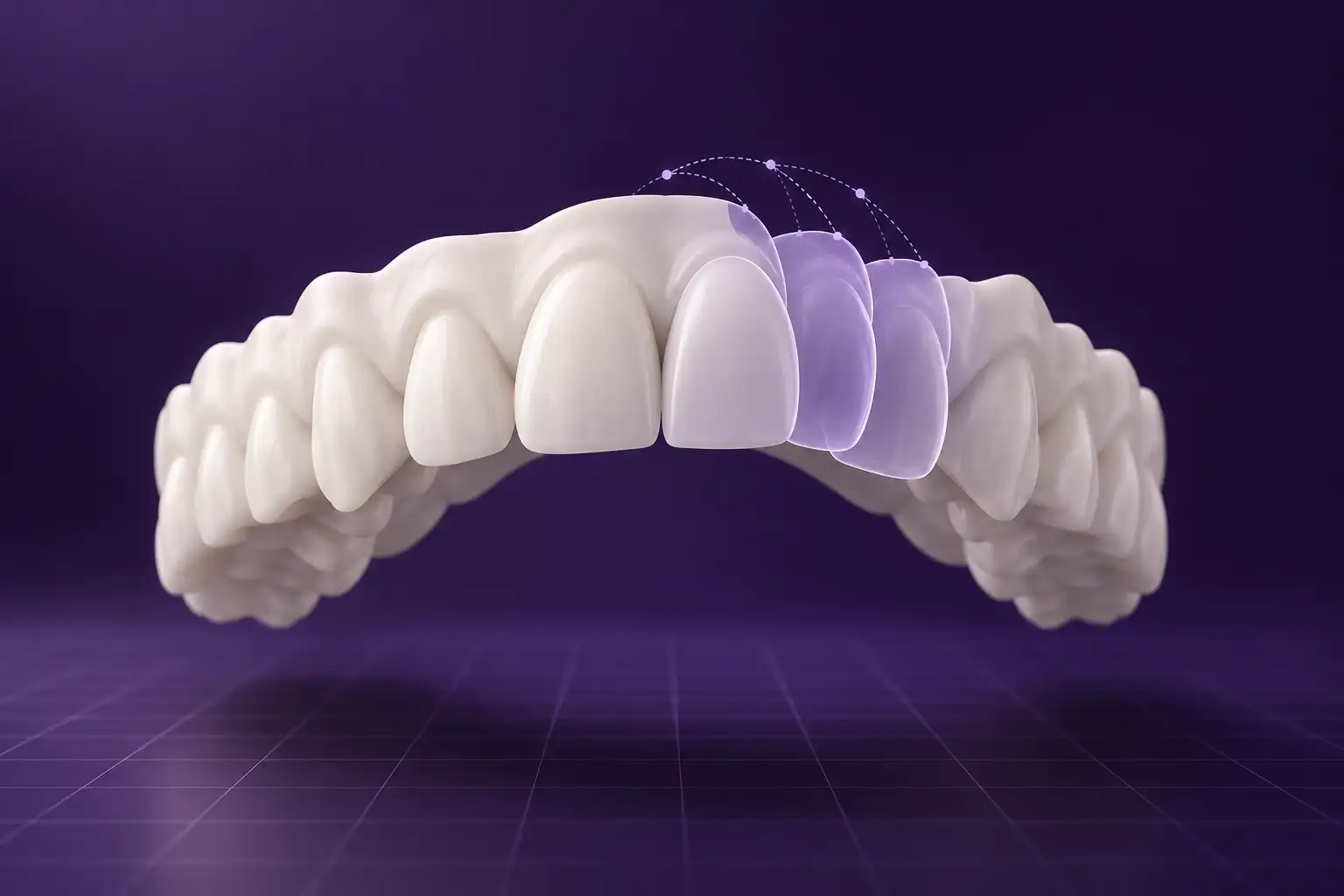
Crowding, explained
The most common reason people look into treatment — and how much of it aligners can realistically fix.

Crowding is what most people mean when they say their teeth are crooked. It happens when there is more tooth than there is jaw to hold it, so teeth rotate, overlap and push out of line.
Why it happens
Jaw size is largely inherited. So is tooth size. When a large set of teeth arrives in a smaller arch, something has to give. It is not caused by anything you did.
Crowding also tends to worsen slowly through adult life, which is why teeth that were straight at twenty are not always straight at thirty-five.
How severity is measured
Clinicians measure the gap between the space available in the arch and the space the teeth need:
- Mild — under 4mm of crowding. Usually treatable with aligners alone.
- Moderate — 4 to 8mm. Often treatable, sometimes with interproximal reduction to create space.
- Severe — over 8mm. Frequently needs extractions, and often needs fixed braces.
Creating space without extractions
Two methods do most of the work. Arch expansion widens the arch slightly to make room. Interproximal reduction removes a fraction of a millimetre of enamel between contacting teeth — painless, and well within safe limits when planned properly.
Both are planned into your treatment before it starts, so you know in advance whether either applies to you.
Why it matters beyond appearance
Crowded teeth are harder to clean. Overlapping surfaces trap plaque where a brush does not reach, which raises the risk of decay and gum disease over time. Straightening is cosmetic in motivation and often functional in effect.
Wondering if this applies to you?
Book a free consultation and we’ll take a look.